
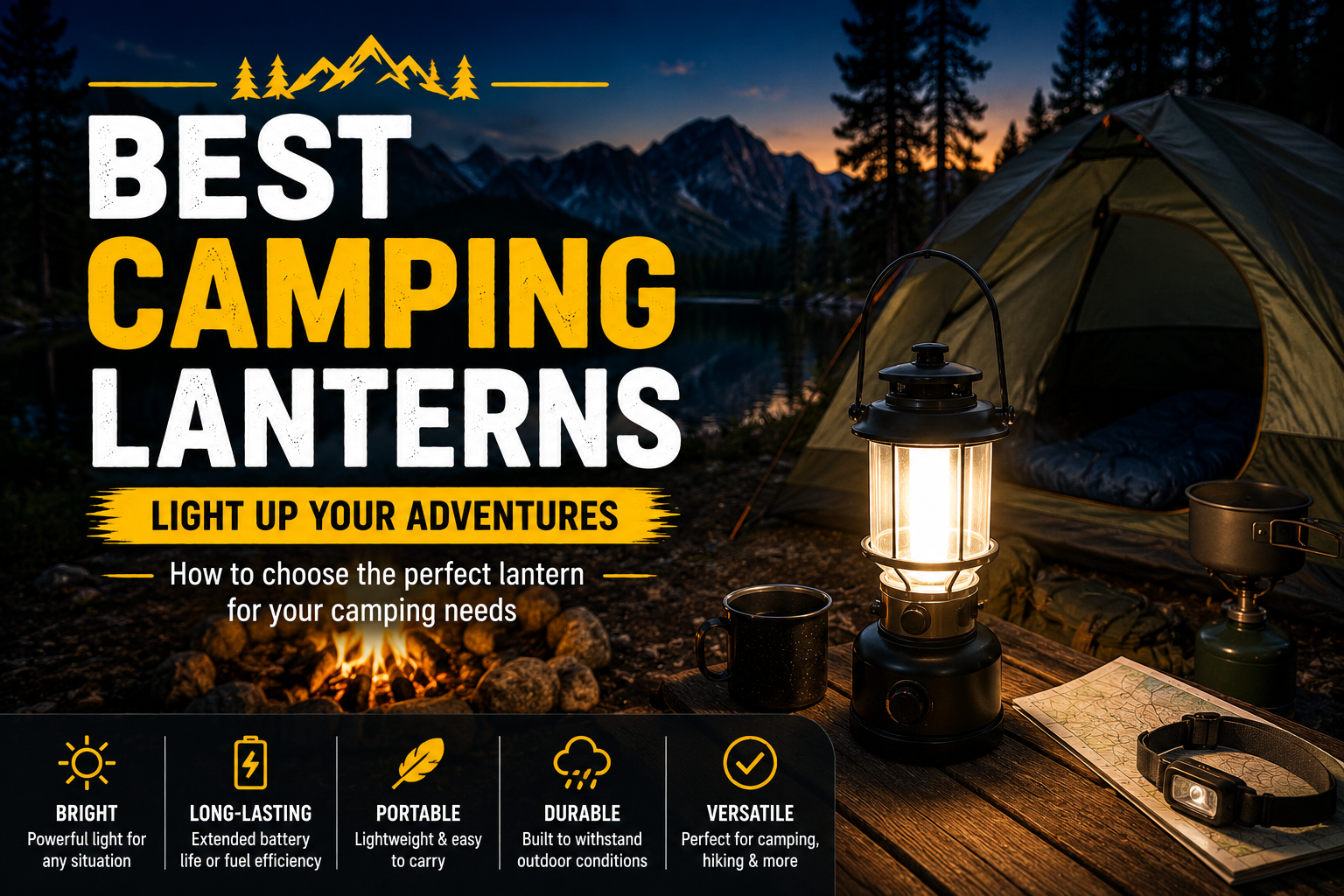
Best Camping Lanterns: How to Choose the Right Lantern for Camping
When the sun goes down, good lighting becomes one of the most important things at your campsite.
Whether you’re cooking dinner, looking for something inside your tent, walking around the campsite, or sitting around the campfire, a reliable lantern can make your outdoor experience much easier and safer.
That’s why choosing one of the best camping lanterns is an important part of preparing for a camping trip.
Modern camping lanterns are available in many different designs. Some are small and lightweight for backpacking, while others are powerful enough to illuminate an entire campsite.
You can also choose between battery-powered, rechargeable, solar-powered, and other lighting options.
So, how do you choose the right one?
In this guide, we’ll explain the most important features to consider, including brightness, battery life, size, weight, durability, charging options, weather resistance, and portability.
Quick Answer: The best camping lantern should provide enough light for your needs, have reliable battery life, be easy to carry, and withstand outdoor conditions. For most campers, a rechargeable LED lantern with adjustable brightness is a versatile option.
Why Do You Need a Camping Lantern?
A flashlight is useful, but it doesn’t always provide the type of lighting you need at a campsite.
A lantern is designed to provide area lighting, allowing you to illuminate a larger space.
A good camping lantern can help you:
- Illuminate your tent
- Light your cooking area
- Find camping equipment at night
- Read inside your tent
- Walk around your campsite
- Prepare food after dark
- Create a comfortable atmosphere
Having reliable lighting is especially important when camping far away from artificial lights.
Best Camping Lanterns by Camping Style
The best lantern for you depends on how you camp.
Best Camping Lanterns for Beginners
If you’re new to camping, look for a lantern that is:
- Easy to use
- Bright enough for general camping
- Portable
- Durable
- Long-lasting
- Easy to recharge or replace batteries
You don’t necessarily need the most powerful lantern available.
A simple LED camping lantern with adjustable brightness can be an excellent starting point.
Best Camping Lanterns for Car Camping
Car camping allows you to bring larger equipment.
If you’re driving directly to your campsite, you can prioritize brightness and features instead of focusing heavily on weight.
Consider a lantern with:
- High brightness
- Multiple brightness levels
- Long battery life
- Large light coverage
- USB charging
- Hanging hooks
- Emergency charging features
A larger lantern can be particularly useful for families and groups.
Best Camping Lanterns for Backpacking
Backpacking requires lightweight equipment.
When you’re carrying everything in a backpack, even small differences in weight can matter.
Look for:
- Lightweight construction
- Compact design
- Long battery life
- Rechargeable battery
- Small packed size
- Durable construction
A small lantern that weighs very little can provide enough light for a tent without taking up valuable space.
Best Lantern for Tent Camping
Your tent doesn’t need the same amount of light as an entire campsite.
For tent camping, look for a lantern that is:
- Compact
- Lightweight
- Dimmable
- Easy to hang
- Battery efficient
A dimmer setting is particularly useful inside a tent because extremely bright light can be uncomfortable.
A lantern with a hanging hook or built-in attachment point can also make it easier to position the light overhead.
What Makes the Best Camping Lantern?
There are several important factors to consider before buying.
1. Brightness
Brightness is one of the most important specifications.
Lantern brightness is commonly measured in lumens.
A higher lumen rating generally means more light output.
However, brighter isn’t always better.
For example, you may want:
- Lower brightness for reading
- Medium brightness for a tent
- Higher brightness for cooking
- Strong illumination for a larger campsite
That’s why adjustable brightness can be more useful than simply choosing the lantern with the highest lumen rating.
2. Battery Life
A bright lantern isn’t very useful if the battery runs out quickly.
When comparing lanterns, check how long they can operate at different brightness levels.
Battery life can vary significantly depending on:
- Brightness setting
- Battery capacity
- Temperature
- Lighting mode
- Battery age
A lantern that offers several brightness levels allows you to conserve power when maximum brightness isn’t necessary.
3. Rechargeable vs. Battery-Powered Lanterns
One of the most important decisions is choosing the power source.
Rechargeable Camping Lanterns
Rechargeable lanterns have built-in batteries that can be charged using a cable.
Advantages
- Convenient
- No disposable batteries required
- Easy to recharge
- Often include USB charging
- Can sometimes be used as a power bank
Disadvantages
- Need to be charged before your trip
- Battery eventually needs replacement
- Charging can be difficult on longer trips without a power source
Rechargeable lanterns are particularly convenient for car camping and shorter trips.
Battery-Powered Camping Lanterns
Traditional battery-powered lanterns use replaceable batteries.
Advantages
- Easy to replace batteries
- Useful for longer trips
- No charging cable required
- Can be convenient in remote locations
Disadvantages
- Requires spare batteries
- Adds additional weight
- Battery costs can add up over time
For extended camping trips, carrying spare batteries can provide extra peace of mind.
Solar Camping Lanterns
Solar-powered lanterns can be charged using sunlight.
They’re particularly interesting for campers who want an additional charging option.
Advantages
- Uses sunlight
- Useful as a backup
- No traditional power source required during charging
Disadvantages
- Charging depends on sunlight
- Can take time to recharge
- Performance may vary in cloudy weather
A solar charging feature is best viewed as a useful backup rather than your only charging method.
4. LED Technology
Most modern camping lanterns use LED lighting.
LEDs are popular because they can provide:
- Good brightness
- Efficient energy use
- Long operating life
- Low heat compared with some traditional lighting technologies
For most campers, an LED lantern is a practical choice.
5. Durability
Camping equipment can experience rough conditions.
Your lantern may encounter:
- Rain
- Dust
- Dirt
- Sand
- Drops
- Transportation
Look for a lantern with durable construction designed for outdoor use.
If you’ll be camping in unpredictable weather, consider a model with an appropriate water-resistance rating.
Always check the manufacturer’s specifications rather than assuming a lantern is waterproof.
6. Size and Weight
The ideal size depends on your camping style.
For backpacking:
Smaller + Lighter = Better
For car camping:
Larger + Brighter = More Options
A compact lantern may be perfect for a tent but insufficient for lighting a large outdoor cooking area.
7. Brightness Settings
A lantern with multiple brightness settings is extremely useful.
For example:
Low
Perfect for:
- Reading
- Sleeping
- Minimal illumination
Medium
Useful for:
- Inside a tent
- Preparing equipment
- Relaxing
High
Useful for:
- Cooking
- Larger campsites
- Group activities
Adjustable brightness also helps conserve battery life.
8. Light Modes
Some of the best camping lanterns offer several lighting modes.
Depending on the model, these may include:
- Warm light
- Cool light
- Flashing mode
- Emergency mode
- Red light
A warm light can create a more comfortable atmosphere around the campsite.
A red-light mode can also be useful in situations where you want less glare.
Camping Lantern vs. Flashlight
You don’t necessarily have to choose between a lantern and a flashlight.
They serve different purposes.
| Feature | Camping Lantern | Flashlight |
|---|---|---|
| Area lighting | Excellent | Limited |
| Directional lighting | Limited | Excellent |
| Tent lighting | Excellent | Good |
| Walking at night | Good | Excellent |
| Cooking area | Excellent | Moderate |
| Hands-free use | Usually | Varies |
For many campers, the best solution is to carry both.
Use the lantern to illuminate your campsite and a flashlight or headlamp when you need directional light.
Best Camping Lanterns for Families
Families often benefit from a lantern with:
- Long battery life
- Multiple brightness levels
- Large light coverage
- Durable construction
- Easy controls
- USB charging
A larger lantern can provide enough illumination for several people while cooking or organizing the campsite.
Best Camping Lanterns for Emergencies
A camping lantern can also be useful outside camping.
You can keep one in:
- Your car
- Emergency kit
- Garage
- Home
- RV
Consider choosing a lantern with long battery life and multiple charging options if you plan to use it as emergency lighting.
Best Rechargeable Camping Lantern Features
If you’re considering a rechargeable lantern, look for:
USB Charging
Makes charging easier.
Battery Indicator
Helps you know when the battery is getting low.
Power Bank Function
Some lanterns can charge phones or other small devices.
Multiple Brightness Levels
Helps extend battery life.
Fast Charging
Can be useful when you have limited access to electricity.
Best Camping Lantern for Cooking
Cooking after dark requires good visibility.
Look for:
- Bright illumination
- Wide light distribution
- Stable base
- Easy controls
- Long battery life
Position the lantern so that it illuminates your cooking area without creating excessive glare.
Always keep lighting devices safely away from open flames and hot cooking equipment.
Best Camping Lantern for Reading
If you enjoy reading inside your tent, you don’t need an extremely powerful lantern.
Instead, look for:
- Adjustable brightness
- Comfortable light
- Warm-light option
- Compact design
- Hanging capability
A lower brightness setting can make reading more comfortable while conserving battery power.
Best Camping Lantern for Kids
When camping with children, simplicity and durability are important.
Look for a lantern that:
- Is easy to operate
- Has protected controls
- Isn’t excessively hot
- Has a stable design
- Can tolerate normal outdoor use
Always supervise children around camping equipment and follow the manufacturer’s safety instructions.
How Many Lanterns Do You Need for Camping?
It depends on the size of your group and campsite.
Solo Camping
One compact lantern may be enough.
Couple
One main lantern plus a flashlight or headlamp is a practical setup.
Family Camping
Two or more lights can make moving around the campsite easier.
A useful setup is:
Main Lantern + Tent Light + Headlamp/Flashlight
This gives you different types of lighting for different situations.
Common Camping Lantern Buying Mistakes
Choosing Only by Brightness
The brightest lantern isn’t automatically the best.
Battery life and adjustability are equally important.
Ignoring Battery Life
Always check operating time at different brightness levels.
Buying a Lantern That’s Too Large
A large lantern may be unnecessary for backpacking.
Forgetting About Charging
Make sure you understand how the lantern is charged or which batteries it requires.
Ignoring Weather Resistance
Outdoor conditions can be unpredictable.
Carrying Only One Light
Having a backup light is always a smart idea.
How to Choose the Best Camping Lantern
Before buying, ask yourself:
Where will I use it?
Tent, campsite, car camping, backpacking, or emergency use?
How much light do I need?
A small tent requires less illumination than a large campsite.
How long will I camp?
Longer trips require more attention to battery capacity and charging options.
Do I prefer rechargeable batteries?
Rechargeable models are convenient, while replaceable batteries can be useful on longer trips.
How much weight can I carry?
Backpackers should prioritize compact and lightweight models.
Will I camp in wet conditions?
If so, check the manufacturer’s water-resistance specifications